


Minimally Invasive (MICS) and Endoscopic Cardiac Surgery
Modern cardiac surgery has evolved significantly in recent years, offering new techniques that reduce surgical trauma and allow for faster recovery for patients. One of the most important developments is Minimally Invasive Cardiac Surgery (MICS), as well as endoscopic cardiac surgery, which enable complex procedures to be performed through small incisions.
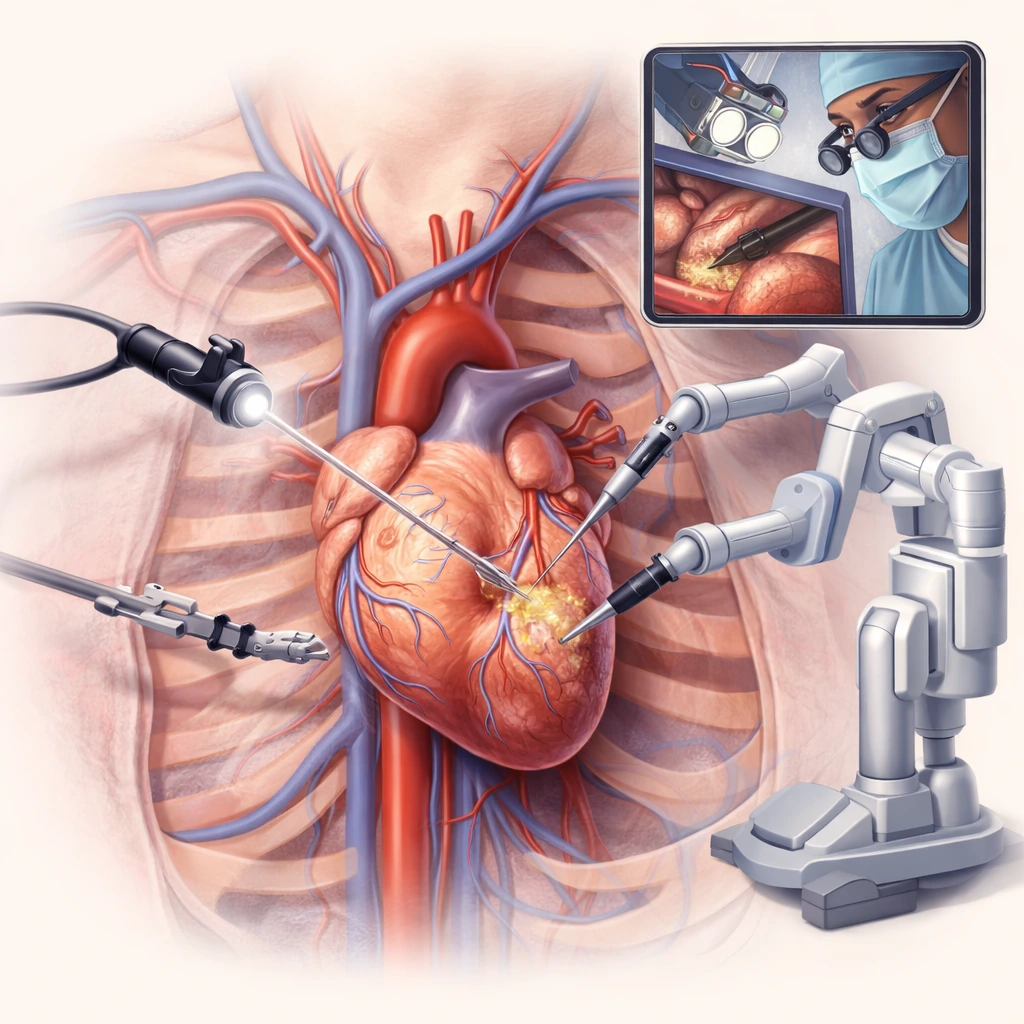
Unlike traditional open-heart surgery, which requires a full opening of the sternum (sternotomy), minimally invasive techniques are performed through small incisions of approximately 4 centimeters, typically on the right side of the chest, using specialized high-precision instruments and endoscopic cameras.
These techniques are now considered among the most advanced forms of cardiac surgery and are performed in specialized centers with extensive experience.
What is Endoscopic Cardiac Surgery
Endoscopic cardiac surgery represents an even more advanced form of minimally invasive surgery.
During the procedure, a high-definition endoscopic camera is used, allowing the surgeon to view the surgical field with magnification.
This technology enables:
- Greater precision of movements
- Improved visual control
- Minimal damage to surrounding tissues
- Safer surgical procedures
What is Minimally Invasive Cardiac Surgery (MICS)
Minimally Invasive Cardiac Surgery (MICS) is a technique that allows cardiac procedures to be performed without the need for a traditional sternotomy.
The operation is carried out through a small incision on the side of the chest, usually at the level of the right breast, with the assistance of specialized instruments and a high-definition camera that enables the surgeon to operate with great precision.
This technique is used in a wide range of cardiac procedures and represents a significant advancement in the treatment of heart diseases.
This approach offers important advantages for the patient, as it is associated with reduced surgical trauma, less postoperative pain, and faster recovery compared to conventional surgical methods. In addition, it reduces hospital stay and the risk of complications, while providing a clearly improved cosmetic result due to the small incision.
Thanks to advances in technology and surgical expertise, minimally invasive cardiac surgery is now considered a safe and effective option for selected patients, contributing to an improved quality of life.
Which Procedures Can Be Performed with MICS
Using minimally invasive cardiac surgery, a wide range of important heart procedures can be performed.
The most common include:
- Mitral valve repair or replacement
- Aortic valve replacement
- Tricuspid valve surgery
- Closure of atrial septal defects
- Removal of cardiac tumors
- Procedures for congenital heart diseases
In selected cases, it can also be used for coronary revascularization procedures.
Advantages of Minimally Invasive Cardiac Surgery
Smaller incision
The incision is only a few centimeters long, significantly reducing surgical trauma.
Less postoperative pain
The absence of sternotomy greatly reduces pain after the procedure.
Lower risk of infections
The smaller surgical wound decreases the likelihood of complications.
Faster recovery
Patients can return more quickly to their daily activities.
Shorter hospital stay
The duration of hospitalization is usually reduced.
Better cosmetic outcome
The small incision leaves minimal scarring.
Which Patients Are Suitable for MICS
Minimally invasive cardiac surgery is not suitable for all patients.
Patient selection is determined after a thorough cardiological evaluation and depends on:
- The nature of the heart condition
- The anatomy of the heart
- The patient’s age
- The overall health status
A specialized cardiac surgeon determines the most appropriate surgical technique for each individual case.
Recovery After Surgery

Recovery After Surgery
After the procedure, the patient is transferred to the intensive care unit for monitoring.
Hospital Stay
The total hospital stay is usually 3 to 5 days, depending on the procedure.
Return to Daily Activities
Most patients can return to their daily activities within a short period of time.
How the Procedure is Performed
During the procedure, a small incision of approximately 4 cm is made at the level of the right breast.
Through this incision, the following are inserted:
- Specialized surgical instruments
- A high-definition endoscopic camera
The surgeon performs the operation with exceptional precision, viewing the surgical field under magnification.
In certain cases, cardiopulmonary bypass may also be used, as in conventional cardiac surgery.
Modern Surgical Techniques
Advances in cardiac surgery have enabled the application of advanced techniques that significantly improve surgical outcomes.
One of the most important developments is endoscopic cardiac surgery, which is performed through smaller incisions.
The advantages include:
- Reduced surgical trauma
- Less postoperative pain
- Faster recovery
- Shorter hospital stay
- Improved cosmetic outcome
The selection of the appropriate technique is based on the individual needs of each patient.
(FAQ)
It is a technique that allows cardiac procedures to be performed through small incisions without opening the sternum.
Yes. When performed by a specialized team, it delivers excellent results.
It is usually about 4 centimeters.
The duration depends on the type of procedure, but it usually lasts between 2 to 4 hours.
Recovery is usually faster compared to traditional cardiac surgery.
Yes, but it is small and usually less noticeable.
With extensive experience in leading international medical centers and numerous scientific distinctions, cardiac surgeon in Athens Dr. E. Andreas Agathos is a reliable choice for patients seeking specialized cardiac care.
He holds a PhD from the University of Athens and is the recipient of significant international qualifications, including:
- FRCS – Royal College of Surgeons of Edinburgh
- FACS – American College of Surgeons
- FETCS – European College of Surgeons
- FICS – International College of Surgeons
Dr. Agathos also holds multiple international patents (World Patent, USA Patent, European Patent) for the development of new biological materials, innovative heart valves, and anti-calcification treatment methods.
He has served as Director of Cardiac Surgery at leading hospitals in Athens, including Hygeia Hospital, Athens Medical Center, and Euroclinic Athens, while also collaborating with top international institutions such as Massachusetts General Hospital in Boston and Triemli Hospital in Zurich.
With more than 5,000 procedures performed in Greece and abroad, he has developed particular expertise in endoscopic cardiac surgery, offering modern and less invasive solutions to patients.
His international experience, scientific innovation, and global patents in the field of heart valves establish Dr. Agathos as one of the most highly specialized cardiac surgeons in modern cardiac surgery.